- Phone: +86-318-8888385
- E-mail: bruce@yongber.com



Sodium Hypochlorite Electrolytic Cell for Chlorine Disinfection Systems
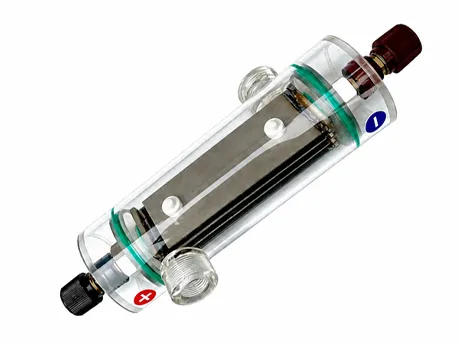
Sodium hypochlorite electrolytic cell is the core reaction unit of a sodium hypochlorite generator, producing sodium hypochlorite (NaClO) disinfectant solution on-site through direct-current electrolysis of 2% – 5% dilute sodium chloride saline solution or seawater. It eliminates the need for high-concentration chemical storage and transportation, reducing corrosion and decomposition risks. Only salt and tap water are required as raw materials, helping lower operating costs. The modular design enables flexible adjustment of cell quantity according to different water treatment scales. It is widely used in water treatment plants, wastewater treatment systems, hospitals, swimming pools, circulating water systems, and aquaculture disinfection.
Features
- Transparent tank design. Enables visual monitoring of electrolysis and electrode scaling conditions.
- Bipolar titanium electrode. Supports De Nora DSA anode and Mahneto MMO anode options with low energy consumption and long service life.
- Independent hydrogen collection chamber. Integrates a dilution exhaust system for improved hydrogen safety.
- Sandwich water-cooling structure. Stabilizes electrolysis temperature, reduces sodium hypochlorite decomposition, and minimizes chlorate by-products.
- Easy installation and maintenance. Supports automatic cyclic acid washing for electrode scale removal.
- Mild disinfection performance. Equipped with a ruthenium-based titanium anode system, reducing corrosion, bleaching damage, and skin irritation.
Working Principle
Dilute sodium chloride brine enters the electrode gap, where electrochemical reactions occur after direct current is applied.
Anode reaction: 2Cl⁻ - 2e⁻ = Cl2 ↑
Cathode reaction: 2H2O + 2e⁻ = H2 ↑ + 2OH⁻
Chlorine generated at the anode reacts directly with sodium hydroxide produced at the cathode:
Cl2 + 2NaOH = NaCl + NaClO + H2O
Overall reaction: NaCl + H2O → NaClO + H2 ↑ (Under direct current electrolysis)
The generated hydrogen is collected and safely discharged after dilution. The produced sodium hypochlorite solution flows out from the upper outlet of the cell and is supplied for chlorine disinfection.
Disinfection Mechanism
Sodium hypochlorite dissolves in water and hydrolyzes to generate hypochlorous acid (HClO). The hypochlorous acid produces oxidative effects that penetrate microbial cell membranes and damage protein structures of bacteria and viruses, achieving effective disinfection and inactivation.
Specifications
- Electrode Plate
- Plate-type Electrolyzer
- Substrate: TA1 pure titanium plate with a thickness of 2.0–3.0 mm.
- Small size (50–300 g/h): 150 × 80 mm, 200 × 100 mm.
- Medium size (500–2000 g/h): 300 × 150 mm, 400 × 200 mm.
- Large modules: 500 × 250 mm, 600 × 300 mm.
- Inter-electrode spacing: 5–8 mm for standard versions; 4–6 mm for De Nora optimized versions.
- Number of plates: 6–48 plates per cell with bipolar stack configuration.
- Plate-type Electrolyzer
- Tubular Concentric Electrode
- Outer anode tube diameter: Ø60 / Ø90 / Ø110 / Ø160 mm
- Inner cathode tube diameter: Ø30 / Ø50 / Ø75 mm
- Effective electrode length: 340 / 580 / 1040 / 1120 mm
- Effective chlorine production per tube: 20–1000 g/h
- Tubular Transparent Acrylic Tank
Table 1: Tubular Transparent Acrylic Tank Dimensions Chlorine Output Outer Diameter × Total Length Pipe Connection Single Tank Volume 20 g/h Ø60 × 340 mm DN15 0.8 L 100 g/h Ø90 × 580 mm DN20 2.2 L 500 g/h Ø150 × 580 mm DN25 5.5 L 1000 g/h Ø180 × 1040 mm DN32 9.8 L 2000 g/h Ø200 × 1120 mm DN40 13.5 L - Model Example: OM-20 Electrolytic Cell
- Dimensions: Length 340 mm; outer diameter Φ60 mm; measurement tolerance ±2 mm
- Brine flow rate: 3 L/h
- Chlorine output: 20 g/h
- Available chlorine concentration: 6–8 g/L
- Operating parameters: Voltage 1–5 V; current 1–30 A
- Electrode configuration: Single-stage electrode
- Brine concentration: 3%
- Power supply: 6 V/40 A
- Connections: Water inlet, water outlet, and sealing fastening nuts
Applications
- Swimming pool water disinfection.
- Municipal water supply and wastewater disinfection.
- Industrial circulating water treatment.
- Seawater organism control for power plants.
- Aquaculture water disinfection.
Inquiry for Our Product
Hengshui Excellent Technology Co., Ltd
E-mail:
bruce@yongber.com
When you contact us, please provide your detail requirements. That will help us give you a valid quotation.